

Last Updated: April 1, 2026
Table of Contents
- What Are the Vulnerabilities of SaaS?
- How Do You Ensure SaaS Security?
- Safeguarding Your SaaS Environment
- What Is SaaS-Based Security?
- What is SaaS security posture management training?
- What Is the Security Policy of a SaaS Company?
- Why are SaaS security controls important?
- How Do You Ensure Data Security in SaaS?
- What Is a SaaS Security Platform?
- What Are the Seven Major Security Issues Relating to Cloud Computing and SaaS?
- What Does the Emerging AI Security Frontier Mean for Cloud and SaaS Security?
- How Is API Security the New Attack Surface for Modern Cloud Attacks?
- How Can You Mitigate SaaS Risks?
- Want To Achieve Better Security With Trava?
- FAQ: SaaS Security and Cloud Computing
Software-as-a-Service (SaaS) and cloud environments have become essential to modern business for their scalability, cost efficiency, and ease of deployment. However, they also introduce new risks that attackers can exploit. If you don’t secure your systems properly, threat actors can exploit SaaS security issues through misconfigurations, identity misuse, data breaches, and third-party vulnerabilities.
To protect data and assets from threat actors, your organization requires more than just compliance checklists. You also need continuous visibility, access control, and proactive monitoring across all cloud services. Before all of that, however, you need to understand the most common threats. From there, you can use a SaaS security checklist to align your defenses with modern SaaS security best practices such as Zero Trust Architecture, data classification, and automated risk assessment.
Below are seven key security challenges in compliance for SaaS and cloud computing. We’ll also cover actionable ways to address each to keep your data, systems, and users secure.
2026 SaaS breaches up 42%—OAuth token theft now bypasses MFA entirely. These 7 foundational risks remain critical, now with AI-powered fixes and 2026 compliance updates for SOC 2 + ISO 42001.
What Are the Vulnerabilities of SaaS?
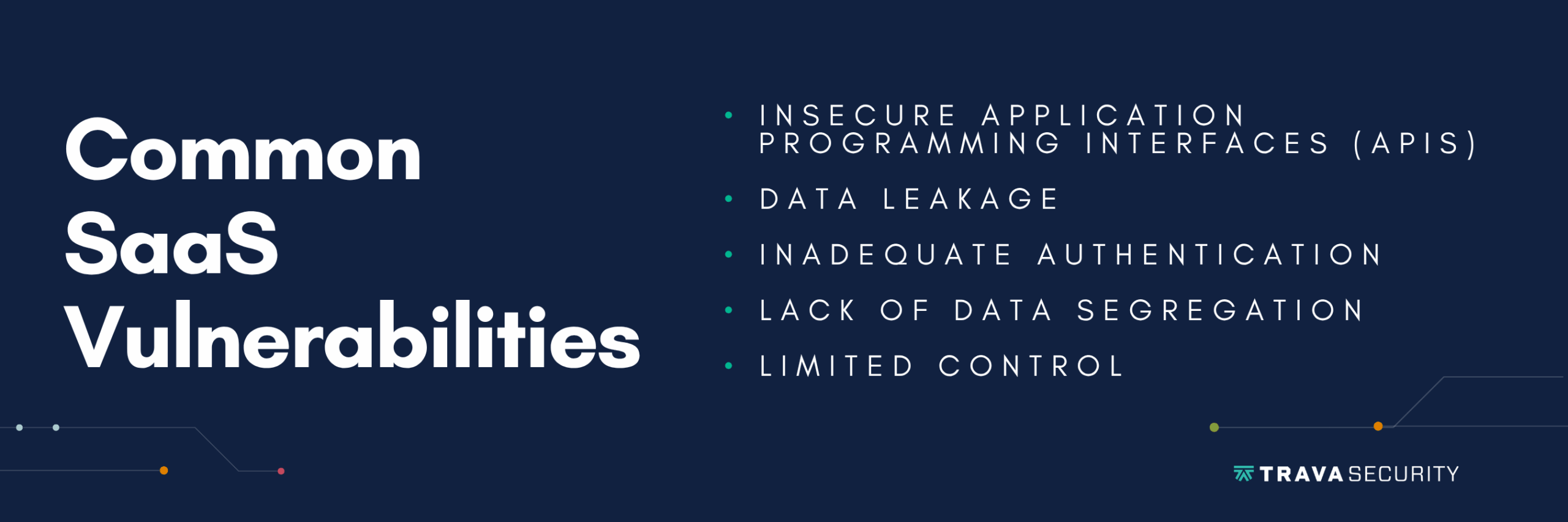
The first step toward keeping your SaaS environment secure is understanding the most common vulnerabilities. Risk assessments help you understand the vulnerabilities inherent in your environment, a crucial component of risk management. Some of the most common vulnerabilities include:
- Insecure application programming interfaces (APIs): Weaknesses in APIs can expose sensitive data to unauthorized access.
- Data leakage: Inadequate data leakage prevention mechanisms can result in the unintentional exposure of sensitive information.
- Inadequate authentication: Weak authentication mechanisms, such as reliance solely on passwords, can compromise security.
- Lack of data segregation: Failing to segregate data properly within a multi-tenant environment can result in data leakage between users.
- Limited control: Organizations may have limited control over security configurations and updates in cloud environments, increasing the risk of vulnerabilities.
How Do You Ensure SaaS Security?
Ensuring the security and compliance for SaaS platforms has never been more important. As organizations increasingly rely on cloud-based solutions, understanding the best practices for SaaS security is crucial.
Once you understand the basics of SaaS security, though, it becomes much easier to safeguard your systems and assets. In this article, we’ll be exploring the key aspects of SaaS security—including how you can use technology-based solutions to your benefit.
Safeguarding Your SaaS Environment
There’s no denying it: SaaS has revolutionized the way businesses operate. The SaaS model offers several advantages over “traditional” software offerings, providing unmatched convenience, scalability, and cost savings.
With the benefits come certain challenges, however—especially when it comes to security. As companies partner with SaaS providers, they have to trust that their critical data and applications will be protected, underscoring the importance of robust security measures.
What Is SaaS-Based Security?
SaaS-based security refers to the measures and protocols organizations put in place to protect data and applications within their broader tech environment. The risk only multiplies when you consider the sheer number of SaaS applications the average business uses—well over 100—and the fact that with each SaaS subscription comes another vendor relationship to manage and another potential set of vulnerabilities.
As organizations continue to invest in SaaS solutions for their operations, they have to consider more than just the value or ROI—adopting a robust security posture is just as critical.
What is SaaS security posture management training?
One of the cornerstones of SaaS security is maintaining a strong security posture. This involves not only putting effective security measures in place, but continuously assessing and enhancing active security measures to address emerging threats and vulnerabilities as well. By undergoing SaaS security posture management training, organizations can gain the knowledge and skills they need to proactively manage security risks and ensure the integrity of their SaaS environment.
Why are SaaS security controls important?
Effective SaaS security controls are essential for safeguarding environments against cyber threats. These controls include identity and access management, encryption, intrusion detection, monitoring tools, and more.
If organizations want to prevent unauthorized access, data breaches, and other security incidents, implementing robust security controls is a critical first step. It’s also important to note that the specific security controls may vary from one application to the next, and should regularly be revisited to ensure that they remain effective against emerging threats.
How Do You Ensure Data Security in SaaS?
Ensuring data security in SaaS involves implementing robust encryption mechanisms, access controls, and regular security audits. For the best results, data should be encrypted—both in transit and at rest—in order to prevent unauthorized access and data breaches.
In order to ensure the integrity and confidentiality of data within any SaaS environment, maintaining industry-specific cloud computing and SaaS security standards is a crucial consideration. These standards, such as ISO 27001, SOC 2, and GDPR, provide guidelines and best practices for implementing robust security measures and compliance requirements.
What Is a SaaS Security Platform?
A SaaS security platform is a set of tools and technologies designed to safeguard SaaS applications and data. You can mostly count on these platforms to adhere to industry standards and regulations, providing organizations with comprehensive security solutions to address present (as well as evolving) threats.
What Are the Seven Major Security Issues Relating to Cloud Computing and SaaS?
As businesses increasingly rely on more SaaS applications to power their day-to-day operations, they must stay alert to new and evolving security risks. The average organization uses over 100 different SaaS applications, ranging from CRM platforms and collaboration solutions to communication channels.
However, the versatility of these applications also introduces unique cyber threats. Below are seven of the most significant security issues facing modern cloud environments.
The seven major security issues in SaaS to consider:
- Access Management
- Cloud Misconfigurations
- Regulatory Compliance
- Storage and Retention
- Risk Management
- Security Monitoring
- Privacy and Data Breaches
Let’s take a closer look at how organizations can address each of these challenges to reduce the risk of a security breach.
Issue 1: How Can Organizations Prevent Access Management (IAM) Failures and Account Hijacking?
Organizations can prevent IAM failures and account hijacking by enforcing layered identity controls, adopting a Zero Trust Architecture (ZTA), and securing non-human identities.
To enforce layered identity controls, IT should give people only the access they need to the business’s systems and data. Additionally, they should use granular permissions, strong password policies, and multi-factor authentication (MFA) to block common attack vectors. Session monitoring also helps catch unusual behavior in real time. Together, this approach reduces risks from both outsiders and insiders.
Organizations can also prevent IAM failures and account hijacking by adopting a ZTA. ZTA strengthens access management by rejecting implicit trust within networks. It follows three core principles:
- Verify explicitly: Authenticate every user and device.
- Use least privilege: Grant only the access needed for a specific task.
- Assume breach: Design systems as if a compromise has already happened.
Another way to prevent IAM failures and account hijacking is through securing non-human identities (NHIs). These digital identities are linked to non-humans like services, applications, or devices, and rely on credentials like API keys, service accounts, and automation scripts, which often have elevated permissions. Modern SaaS ecosystems use NHIs to authenticate and interact with systems autonomously.
SaaS cybersecurity teams must treat NHIs with the same care as human accounts to protect them from threat actors. Ways to safeguard them include storing them in dedicated vaults, automating key rotation, applying least privilege, and monitoring for anomalous usage.
Issue 2: How Can Organizations Avoid and Correct Cloud Misconfigurations?
Organizations can avoid and correct cloud misconfigurations by implementing technology and software development approaches.
On the tech side, consider adopting cloud security posture management (CSPM) platforms and SaaS security posture management (SSPM) tools. CSPM tools fix core configuration risks in diverse Platform-as-a-Service (PaaS) and Infrastructure-as-a-Service (IaaS) assets, while SSPM focuses on securing SaaS applications. Cybersecurity teams can use them together to standardize controls across multiple cloud providers and minimize human error.
Besides adopting tools like CSPM and SSPM, organizations also need to take a security-first approach, such as shift-left testing in DevSecOps. This requires integrating security practices like Infrastructure-as-Code (IaC) scanning early in the software development lifecycle, so teams can identify and fix cloud misconfigurations before they become critical.
Issue 3: How Can Businesses Maintain Regulatory Compliance in the Cloud?
To maintain regulatory compliance in the cloud, businesses must take a proactive, multipronged approach that includes following compliance frameworks, running regular security audits, and addressing data sovereignty requirements.
Companies need to comply with every framework that applies to them. Depending on where your customers and users are located, where your company is situated, and other factors, relevant laws may include the Health Insurance Portability and Accountability Act (HIPAA), Payment Card Industry Data Security Standard (PCI DSS), General Data Protection Regulation (GDPR), California Privacy Rights Act (CPRA), and Cybersecurity Maturity Model Certification (CMMC).
Following these frameworks provides several benefits, including data handling, user consent, and breach notification processes that meet global standards. It also demonstrates your commitment to data protection, setting you apart in a crowded market. Finally, it can protect you from lawsuits, reputational damage, and hefty fines that arise if you don’t follow a framework when you should.
Besides following the right compliance frameworks, businesses also need to run regular security audits. This lets you:
- Identify vulnerabilities more easily, so your team can fix them before threat actors exploit them.
- Verify that policies match regulatory requirements and confirm that SaaS vendors meet compliance obligations.
Additionally, organizations should address data sovereignty requirements. These laws govern data based on its physical location and may require companies holding sensitive information to store and process it within specific regions. For example, the GDPR requires personal data belonging to EU residents to be stored, processed, and transferred only in compliance with EU data protection standards. In practice, this means data can’t be moved to countries outside the EU or EEA unless those countries provide “adequate” protection as defined by the EU Commission. Organizations should verify that their SaaS providers offer region-based data centers and maintain control over where data physically resides.
Issue 4: How Can Companies Securely Store and Protect Customer Data?
Companies can securely store and protect customer data in several ways. First, you can encrypt data in transit and at rest. Encryption ensures that sensitive information is unreadable to unauthorized users, making it less likely for a threat actor to steal or intercept it during transmission.
You can also implement robust key management to harden defenses against ransomware and unauthorized decryption. For example, you can adopt automated key rotation, limited access, and dedicated encryption vaults.
To further reduce risks, you should also adopt data loss prevention (DLP) tools. These systems monitor, detect, and block potential data leaks in real time, giving visibility into suspicious activity and helping teams respond before damage happens.
Immutable backups and disaster recovery plans add another layer of resilience. Since they can’t be deleted or altered, they provide a reliable fallback if an attack happens. When paired with well-tested recovery procedures, they empower cybersecurity teams to quickly and confidently restore operations after outages or breaches.
Classifying and prioritizing sensitive data can also help you securely store and protect customer data. By making a database showing which types of data are the most sensitive, where data is located, and who has access to it, you can create more precise access controls and allocate stronger protections where they matter most.
Issue 5: How Can Organizations Manage and Mitigate Vendor or Third-Party Risks?
Organizations can manage and reduce third-party risks by treating every vendor as part of their security perimeter. Before bringing on any vendor, evaluate its security controls, data protection policies, and incident response plans. Once a vendor is active, don’t take vendor security for granted. Sometimes, vendors may forget to patch certain software or miss a vulnerability, which can affect you and other people using their software and services. Regularly review your supplier’s compliance status, breach history, and certifications (such as SOC 2 or ISO 27001).
Supply chain threats deserve special attention. A single breach at an HR, finance, or analytics vendor can quickly ripple through the entire client network. To minimize exposure, map every vendor dependency by documenting each provider’s role and assessing how data flows between systems. You should also restrict data sharing to the bare minimum required for business operations. This reduces the potential blast radius if a third-party system is compromised.
Last but not least, embed vendor risk policies into your contracts with them. Set clear security standards, permit regular audits, and include the right to inspect vendor systems if an incident happens. Written expectations make it easier for you to protect yourself.
Issue 6: How Can Businesses Continuously Monitor and Respond to Security Threats?
Businesses can stay ahead of threats by watching their systems in real time, automating how they respond, and keeping all activity data in one place.
Continuous monitoring security solutions give security teams instant awareness of what’s happening across their SaaS environments. When something strange happens, like a spike in traffic or a login from a foreign country, they trigger instant alerts so that security teams can investigate and contain issues before they escalate.
Automation makes the response even faster. Security Orchestration, Automation, and Response (SOAR) platforms connect different security systems and handle repetitive tasks automatically. By reducing manual work, SOAR helps teams respond to threats more quickly and with fewer mistakes.
Finally, visibility ties everything together. Centralizing all logs into a single security information and event management dashboard eliminates blind spots that come from scattered data. When analysts can see activity across every cloud and SaaS platform, they can detect patterns, trace attacks, and strengthen weak points before SaaS security challenges spread.
Issue 7: How Can Companies Protect Data and Privacy From Breaches?
Companies can protect private data such as intellectual property and personally identifying information by combining strong access controls, early security threat detection, and fast, coordinated responses when something goes wrong. This helps establish and maintain customers’ trust, since over time, dedication to these forms of protection shows clients you care about protecting them and are agile and alert to new or emerging threats.
Unauthorized access or data breaches are one of the biggest dangers in SaaS environments. These breaches often happen due to weak passwords, reused credentials, or missing encryption, all of which can give attackers an opening. Preventing unauthorized access requires investing in strong authentication methods, such as multi-factor verification and adaptive access policies. Encrypting data both in transit and at rest can also limit what hackers can do, even if they gain partial access.
However, not all potential threats come from the outside. Insider risks — employees or contractors who act carelessly or maliciously — can be just as damaging. Fortunately, you can reduce this exposure by limiting access to sensitive systems and keeping a close eye on privileged accounts. User Behavior Analytics (UBA) tools help by learning what normal activity looks like and flagging unusual behavior, such as excessive downloads or off-hours logins.
After updating policies for granting access, you may also consider implementing a single sign-on system (SSO). These minimize the number of passwords employees have to manage, which encourages the use of stronger, unique passkeys. It also centralizes your authorization process to help with the uniform application of your security policies.
To wrap it up, you should have a clear incident-response plan. That way, when a breach occurs, security teams already know who to involve first, how to isolate systems, and how to communicate transparently with customers and regulators. The quicker and more disciplined your actions are, the more likely you are to contain damage and preserve the trust that security is meant to protect.
3 Critical SaaS Security Threats That Emerged in 2026
The original 7 risks remain foundational, but 2026 introduced attack vectors that now dominate breaches. Here’s what SaaS CISOs must address immediately:
1. OAuth Token Hijacking (56% of 2026 SaaS Breaches)
Stolen OAuth tokens bypass MFA entirely. Attackers phish short-lived codes → exchange for long-lived tokens → full app access for months.
The numbers:
Statistic |
Impact |
| 56% of SaaS breaches | OAuth-related (up from 19% in 2025) |
| 92 days avg dwell time | Before detection |
| $4.2M avg breach cost | Token hijacking incidents |
Fixes that work:
- Continuous session monitoring (not just login alerts)
- Token rotation policies (7-day max lifetime)
- OAuth audit logs reviewed weekly
2. SaaS Data Sprawl (237 Shadow Apps Per Company)
Employees bypass security with unapproved tools. Security teams discover 46% of apps post-breach.
The sprawl reality:
Your SaaS stack probably looks like this:
✅ Approved (47 apps): Slack, Salesforce, GitHub
❌ Shadow (190 apps): Canva, Typeform, custom ChatGPT wrappers
Fixes that work:
- SaaS Access Management (SSPM) tools
- Domain-wide app controls (Google Workspace, Okta)
- Quarterly shadow app discovery scans
3. Shadow AI Deployments (67% of Companies)
Teams deploy AI wrappers, custom agents without security review. Finance builds GPT-4o for forecasting, HR creates sentiment analysis—all outside security controls.
The risk breakdown:
AI Deployment |
Risk Level |
Example |
| ChatGPT + internal data | Critical | Customer PII exposure |
| Custom AI agents | High | LLM prompt injection |
| Third-party AI plugins | Medium | Data exfiltration |
Fixes that work:
- AI governance policy (mandatory security review)
- LLM security scanning (prompt injection detection)
- Approved AI vendor list (5 max)
What Does the Emerging AI Security Frontier Mean for Cloud and SaaS Security?
Generative artificial intelligence (AI) tools like ChatGPT and CoPilot have transformed the way attackers and defenders operate in cybersecurity.
Thanks to Gen AI, threat actors can create highly convincing phishing emails, fake login portals, or deepfake video content, even with limited experience. What’s even more frightening is that they can analyze public profiles, company data, and writing styles to personalize these scams at scale. As a result, traditional spam filters and awareness training have become less effective.
To stay protected, organizations need to fight AI with AI. AI-powered threat detection systems can analyze vast amounts of network and user activity data, spotting anomalies that humans might overlook. At the same time, you must set clear policies around how employees use third-party AI tools, so they don’t share sensitive data with unsecured or publicly trained models. Otherwise, you may expose yourself to additional legal and security threats.
How Is API Security the New Attack Surface for Modern Cloud Attacks?
APIs enable data exchange between applications, users, and services, making them a core part of the company infrastructure. That’s why they’ve become the primary entry point for modern cloud attacks. If you don’t properly secure them, they can expose sensitive data, authentication tokens, or even full system access.
One of the most common API vulnerabilities is Broken Object-Level Authorization (BOLA), which happens when an attacker manipulates object IDs or endpoints to access other users’ data. Other API issues, such as weak authentication or unvalidated input parameters, can also cause massive leaks and service disruptions.
To minimize these risks, organizations should enforce strong authentication and authorization for every API, use rate limiting to prevent abuse, and regularly perform API-specific security testing. Centralized API gateways and continuous monitoring also help detect anomalies early and block malicious traffic before it reaches critical systems.
How Can You Mitigate SaaS Risks?
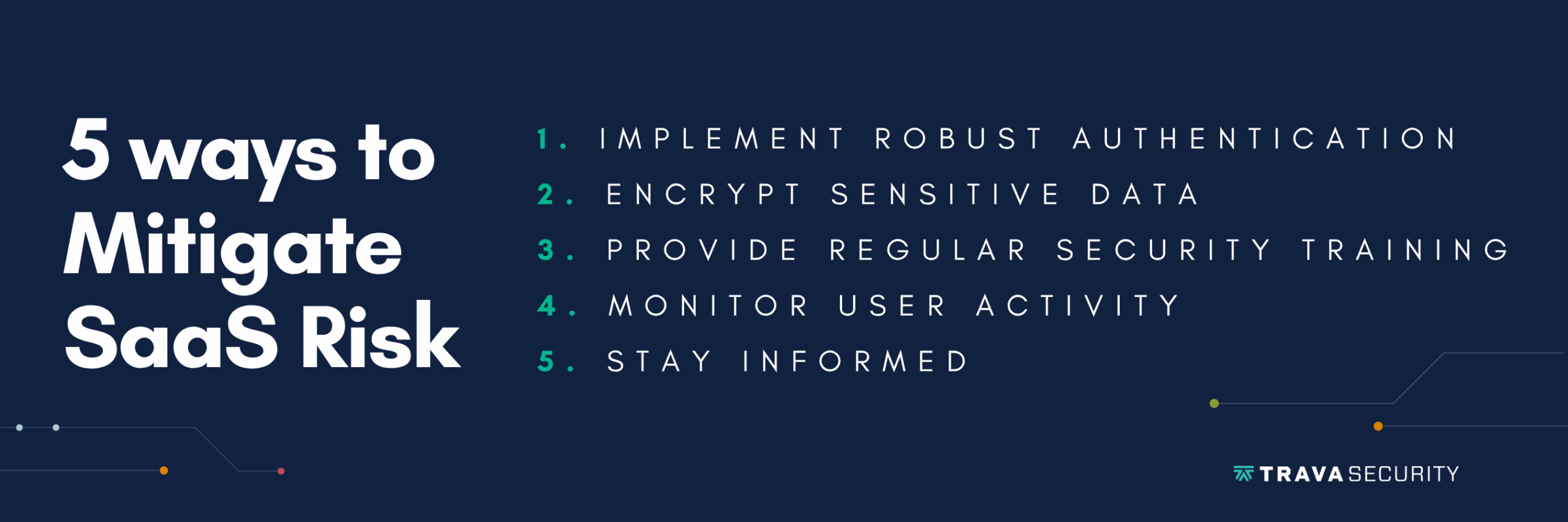
When it comes to SaaS security, companies have little room for error. Mitigating risks requires a proactive, multi-layered approach to security that combines technology, training, and ongoing vigilance. Here’s how you can get started:
- Implement robust authentication: Enforce strong authentication measures, such as multi-factor authentication (MFA), to prevent unauthorized access to platforms.
- Encrypting sensitive data: Use encryption technologies to protect sensitive business and personal information from unauthorized access in transit and at rest.
- Provide regular security training: Educate employees about SaaS security best practices and how to recognize emerging threats, including AI-generated ones.
- Monitor user activity: Use user activity monitoring security tools to detect suspicious behavior and unauthorized access attempts before they escalate.
- Stay informed: Mitigating SaaS risks is a long-term goal. Regularly stay up to date on new vulnerabilities, threat reports, and security updates in the SaaS ecosystem. For example, if you hear about a brute force attack targeting one of your key vendors or a platform you rely on, act immediately by resetting passwords. Acting quickly protects sensitive data before threat actors can get to it.
You can also consider adopting a shared responsibility model. This means splitting the responsibility for different security processes with a third party, such as a cloud computing provider. It can reduce the amount of security work you process internally to manage your team’s workload. There are also platform-as-a-service models that give your team access to tools they need without adding a responsibility to manage the underlying security infrastructure.
Want To Achieve Better Security With Trava?
Protecting your systems from SaaS security issues is critical in today’s digital age. By understanding the top security issues and implementing proactive security measures, organizations can mitigate risks and safeguard sensitive data effectively. The next step is completing your SaaS security assessment with Trava’s cybersecurity experts.
Ready To Learn More About Safeguarding Your SaaS Platform?
At Trava, we’ve built a platform that brings together a unique set of cybersecurity compliance features, including data privacy services, vulnerability management, and more. Contact us today to speak with a security expert and take your first step toward a more secure SaaS environment.
FAQ: SaaS Security and Cloud Computing
1. What are the most common vulnerabilities in SaaS environments?
The most common SaaS vulnerabilities include insecure APIs, data leakage, inadequate authentication, lack of data segregation, and limited control over security configurations in cloud environments. Understanding these risks helps organizations prioritize protections and conduct effective risk assessments.
2. How can organizations ensure SaaS security?
Organizations can ensure SaaS security by implementing robust authentication (such as multi-factor authentication), encryption for data at rest and in transit, continuous security monitoring, and regular audits. Adopting SaaS security controls, posture management, and a clear security policy further strengthens protection.
3. What is SaaS-based security?
SaaS-based security refers to the measures and protocols organizations use to protect data and applications in cloud-based software platforms. It involves managing multiple vendor relationships, monitoring access, enforcing encryption, and proactively mitigating potential risks.
4. How does SaaS Security Posture Management (SSPM) help?
SSPM training and tools help organizations maintain a strong security posture by continuously assessing and enhancing security measures, addressing vulnerabilities, and ensuring compliance with industry standards.
5. What is a SaaS security policy?
A SaaS security policy outlines procedures for access control, data encryption, and incident response. Reviewing the security policies of SaaS vendors ensures that your organization works with reputable providers and maintains a strong security posture.
6. What are the seven major security issues in SaaS and cloud computing?
The seven major security issues include:
- Access Management
- Cloud Misconfigurations
- Regulatory Compliance
- Storage and Retention
- Risk Management
- Security Monitoring
- Privacy and Data Breaches
7. How can organizations prevent access management failures and account hijacking?
By enforcing layered identity controls, adopting a Zero Trust Architecture (ZTA), securing non-human identities, using strong passwords, multi-factor authentication, and session monitoring, organizations can prevent unauthorized access and account hijacking.
8. How can businesses address cloud misconfigurations?
Businesses can reduce cloud misconfigurations by adopting Cloud Security Posture Management (CSPM) and SaaS Security Posture Management (SSPM) tools, integrating security into DevOps practices, and performing early Infrastructure-as-Code (IaC) scanning.
9. How can SaaS companies maintain regulatory compliance?
Organizations should follow applicable frameworks like HIPAA, PCI DSS, GDPR, CPRA, or CMMC, conduct regular security audits, and comply with data sovereignty requirements to maintain regulatory compliance in cloud environments.
10. How can companies secure customer data in SaaS?
Customer data can be secured through encryption, key management, data loss prevention tools, immutable backups, disaster recovery plans, and data classification to prioritize sensitive information.
11. How can organizations manage vendor or third-party risks?
Organizations should evaluate vendor security, monitor compliance, map supply chain dependencies, restrict data sharing, and include clear security expectations in contracts to mitigate third-party risks.
12. What role does AI play in SaaS security?
Generative AI introduces new threats, such as highly personalized phishing and deepfake attacks. Organizations can counteract these risks using AI-powered threat detection and clear AI usage policies for employees.
13. Why is API security critical in cloud environments?
APIs are a major attack surface, often targeted due to weak authentication, Broken Object-Level Authorization (BOLA), or unvalidated inputs. Strong authentication, centralized API gateways, rate limiting, and continuous monitoring help reduce risk.
14. What steps can organizations take to mitigate SaaS security risks?
Mitigation involves multi-layered security: strong authentication, encryption, continuous monitoring, user activity tracking, employee training, and staying informed about emerging threats, including AI-driven attacks.
15. What is a SaaS security platform?
A SaaS security platform provides a set of tools and technologies to protect applications and data, ensuring compliance with security standards like ISO 27001, SOC 2, and GDPR while mitigating current and evolving security threats.
16. How can companies ensure a secure SaaS future?
By adopting best practices, investing in robust security platforms, training employees, and aligning with industry standards, organizations can safeguard sensitive data, maintain operational continuity, and reduce exposure to SaaS security risks.